MechDSL
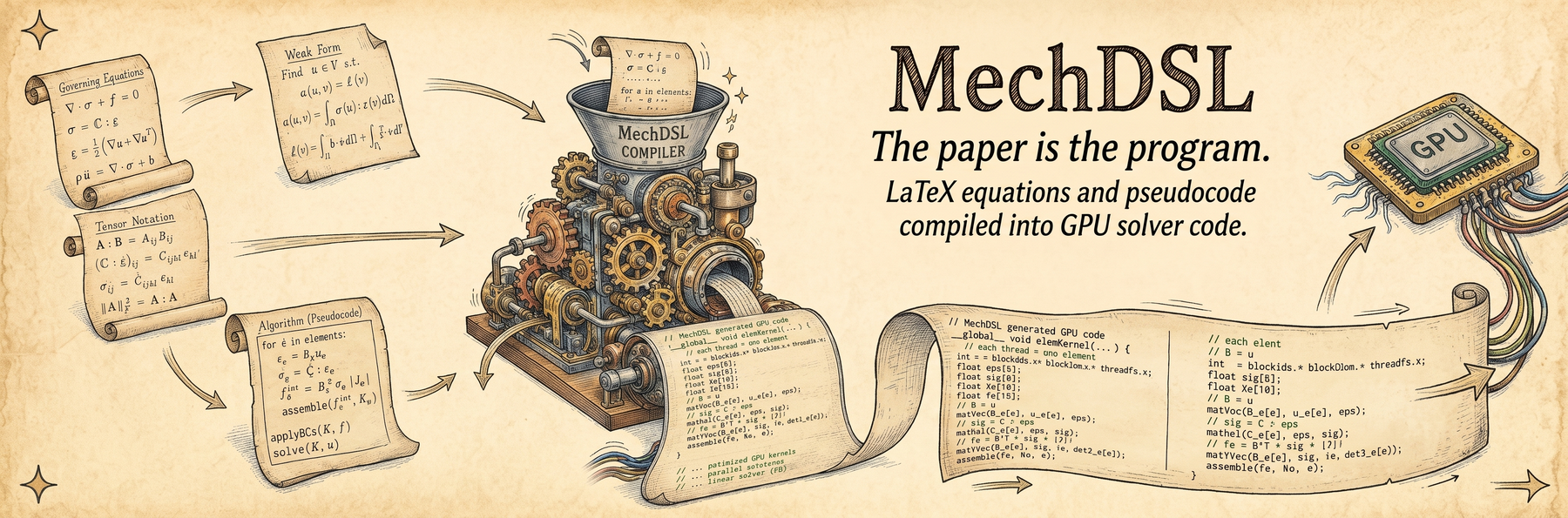
Write your mechanics in LaTeX. Get a tested finite-element solver back.
MechDSL is a monorepo of LaTeX-to-code compilers for computational solid mechanics. You describe the math — a boundary-value problem, a strain-energy function, a return-mapping algorithm — in an ordinary LaTeX document, and the toolchain emits deterministic, tested Taichi solver code.
The same .tex file renders normally through pdflatex and is executable input to
the compiler. Your paper's source can be your simulation's source. The guiding principle:
Derive models from LaTeX; don't hand-code what the compiler should generate.
Install it
Everything is on PyPI under the MIT license:
pip install mechdsl-core              # the compiler: LaTeX -> emitted solver source (Taichi-free)
pip install "mechdsl-core[verify]"    # the full engine: run and verify solves
Or skip the scripting entirely and drive it from a browser:
See Installation for every package, extra, and the from-source workflow.
The packages
-
The FEM compiler. Turns
% mechanicsdirectives and strain-energy functions into element kernels, deriving stress S = ∂Ψ/∂E and tangent C = ∂²Ψ/∂E² symbolically. Six-layer pipeline, Total Lagrangian, Hex8, Taichi backend.pip install mechdsl-core -
The algorithm transpiler. Turns LaTeX
algpseudocodeboxes — return-mapping loops, the PCG solver — into executable code. Zero runtime dependencies. Consumed by mechdsl-core for everything that isn't a closed-form expression.pip install algo2code -
The neutral Taichi runtime. Vector primitives, Tier-1
@ti.functensor helpers, and the injection seams that generated bodies plug into. Generated code depends on this, never on the compiler that produced it.pip install ti-runtime -
The companion browser app: LaTeX on the left, compiled mechanics or transpiled algorithm on the right. Lives in its own repository; the fastest way to try the language before committing to the pipeline.
pip install "mechdsl-workbench[mechdsl]"
The three monorepo packages have strict, one-way relationships. mechdsl-core consumes
algo2code-generated artifacts; algo2code is runtime-free and never imports mechdsl;
ti-runtime is what generated code lands on and never imports mechdsl either. Together
they cover both halves of a constitutive model — the closed-form energy (differentiated
by mechdsl-core) and the iterative algorithm (transpiled by algo2code) — plus the runtime
floor they both emit against.
A 60-second taste
from mechdsl import compile_latex

source = r"""
% mechanics dim 3
% mechanics cell hex8
% mechanics formulation total_lagrangian
% mechanics material svk --E 200e3 --nu 0.3
% mechanics boundary fix  --type dirichlet --value 0 --components 0 1 2
% mechanics boundary load --type neumann --traction "0 0 -1000"
"""

bundle = compile_latex(source)
print(bundle.element_ir_summary)   # what got localised (element, quadrature, einsum specs)
print(bundle.content_hash())       # deterministic — same input, same hash, every time
That call runs the full pipeline: parse the directives → build the Mechanics IR →
localise to an Element IR → plan the tensor contractions → emit Taichi. It needs only the
base pip install mechdsl-core — no Taichi required to emit.
Where to go next
- Just want it installed? Installation covers PyPI, the extras,
and the
uvsource workflow. - New here? Start with the mechdsl-core introduction — it's the main package.
- Want to run something? Getting started takes you from a fresh install to a compiled solver bundle.
- Prefer clicking to typing? The browser workbench runs the same compiler behind a UI.
- Curious about the design? How it works is a guided tour of the six layers, and the FAQ answers the common questions.